Vigilante justice
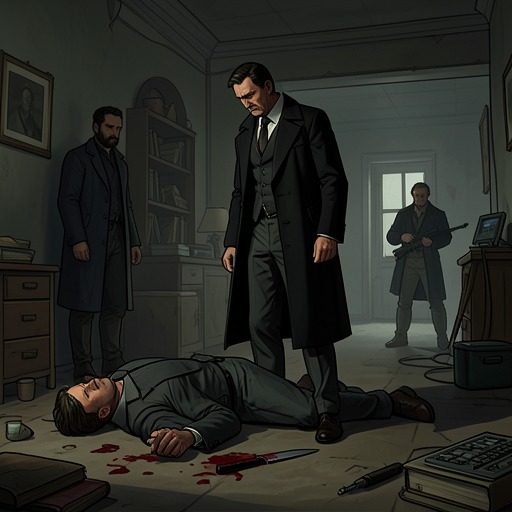
Man on FireVigilante justice is the novel’s conflict between Creasy’s private campaign of revenge and Mario Satta’s responsibility to apprehend killers under a compromised legal system. Creasy’s pursuit of Floriano Conti and Don Cantarella gives that conflict immediate stakes; Satta’s response makes it a question not only of conscience, but of who may bend the law and on what terms. The novel places personal retaliation beside a history in which organized crime has grown powerful partly through the weakness and infiltration of formal institutions.
A Compromised Legal Order
The novel describes postwar Italy as a place where liberation restored both ordinary justice and criminal power. Under Fascist and German rule, criminals had been suppressed alongside innocent people; when the Americans released the innocents, the criminals were released too. The account’s deliberately paired formulation—justice and crime returning together—makes clear that the end of repression did not by itself establish a trustworthy order. It reopened space for law, but also for those who could exploit it.
Floriano Conti represents a changing form of criminal authority within that order. In his mid-thirties, he had established his territory through violence, then adopted the posture of a practical businessman. Recognizing that power could be used more effectively through cooperation, he agreed to meetings with emissaries from Palermo to define spheres of influence and rank among nationwide bosses. Criminal power here is not presented only as individual force: it is organized, negotiated, and made durable through arrangements between leaders.
The broader description of the Mafia explains why formal justice offers an uncertain answer. The organization is said to defy the police, at times control them, subvert courts, bribe politicians from local councils to Cabinet ministers, and exercise law in some southern areas and in Sicily. It can also operate inside prisons and draw on informers and strong-arm groups across towns and villages. The police, the Carabinieri, courts, and prisons are described as weapons often corrupted or infiltrated. Efforts by authorities—including a major trial in Reggio over corruption and the forced purchase of land for a steel complex—indicate that the state does act, but the account stresses the weakness of the system. This is the environment in which private retaliation can appear effective without becoming lawful justice.
Creasy’s Pursuit
Mario Satta is astonished when he learns that Creasy intends to continue after killing Dino Fossella and is now going after Conti and Don Cantarella. Satta had expected the revenge to end with Fossella’s death and Creasy to flee across the border to a distant country. The revelation changes the scale of the matter: Creasy is not treating one killing as the completion of his task, but pressing onward against the leaders above Fossella.
That continuation gives Creasy’s campaign an effect beyond its private purpose. Satta recognizes that a single man’s actions have struck at the Mafia’s pride. If Creasy reaches Conti, the damage to the organization could be severe; if he kills Cantarella, Satta considers the potential wound still more consequential. The narrative therefore presents vigilantism as both a threat to criminal power and a challenge to the order that claims the right to restrain it. Creasy’s actions may weaken the Mafia, but they do so outside the process Satta is sworn to uphold.
Satta’s Crisis of Propriety
Satta distinguishes his dilemma from a crisis of conscience. He takes pride in having put his conscience away, imagining that he might open it one day when cynicism no longer satisfies him. His immediate struggle is instead about propriety: he believes laws can and should be bent, but insists that laws must exist and that the right to bend them belongs, tacitly, to their enforcers. Creasy’s conduct presents an opportunity because it may strike powerful criminals; it also affronts Satta’s sense of who is entitled to act beyond the strict letter of the law.
That distinction gives Satta’s position its tension. He does not simply equate legality with justice, since he accepts that law may need to bend. Nor does he treat a desirable outcome as permission for anyone to take the law into their own hands. In his view, discretion belongs to those who enforce the legal order, not to a private avenger. The difference is less between perfect law and perfect morality than between authorized discretion and an act that bypasses the authority Satta regards as essential.
The narration says that Satta wrestles with this question late into the night and reaches a dignified compromise, but the supplied account does not specify the compromise’s precise terms. Elsewhere, an exchange asks what the American is doing and invokes the belief that vengeance belongs to God. The sequence then records a decision expressed through the idea that a man should know, without establishing here exactly what action follows. These moments place personal knowledge, religious restraint, and the decision to act near one another, while leaving the full resolution of the dilemma unstated.
The Limits of Private Justice
The responses of Guido Arrellio and Massimo Bellu extend the conflict beyond Satta’s private reasoning. Guido sharply rebukes the colonel, while Bellu answers that the colonel bears no personal responsibility for Creasy but sympathizes with him and will do everything he can. Their exchange distinguishes responsibility from sympathy: an official may understand the human or practical force of Creasy’s campaign without being accountable for, or simply directing, his actions. It also shows how those around the pursuit negotiate between personal allegiance and the constraints of institutional office.
The novel does not make Creasy’s success, as described in these passages, equivalent to a repaired justice system. The Mafia’s strength rests on networks of political influence, intimidation, and infiltration, not merely on the survival of a few bosses. Conversely, Satta’s insistence on propriety does not erase the compromised institutions in which he serves. Vigilante justice occupies this gap: it can threaten an entrenched criminal order where official authority is weak, yet its force comes from an individual acting without the procedures or mandate that distinguish enforcement from revenge. The resulting unease is central to the theme. The novel recognizes the appeal and possible impact of private retaliation while preserving the unresolved question of whether a blow against criminal power can count as justice when it is delivered outside the law.